
Kinematics of frictional melts at the base of the world’s largest terrestrial landslide
Sat, 10/02/2021 - 6:44pmTop Stories
The University of Louisiana at Lafayette takes IBA AAPG North America Semi-Final 1st place
Proud to share that the IBA team at University of Louisiana at Lafayette earned 1st place at the North American Semi
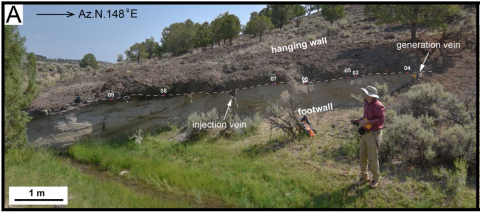
A pseudotachylyte is a very special kind of rock produced by frictional heating. In general these rocks are found along seismogenic faults or associated with asteroid impacts, both catastrophic events.
A new occurrence of these rocks was recently found at the base of a gigantic landslide (70 km displacement, ~5,000 km2) that took place in Utah 23 Million years ago.
Nina Zamanialavijeh just published her Master’s research in the Journal of Structural Geology. Her study shows that the flow fabric of the frictional melt precisely tracks the slide direction and therefore can be used to quantify viscous flow in similar materials where the direction of transport is unknown.