
Past climate warming driven by hydrothermal vents
Tue, 08/08/2023 - 7:53amTop Stories
The University of Louisiana at Lafayette takes IBA AAPG North America Semi-Final 1st place
Proud to share that the IBA team at University of Louisiana at Lafayette earned 1st place at the North American Semi
Dr. Ferre' co-authors a new study on Nature Geosciences showing how volcanism 56 million years ago released more methane than thought.
The Paleocene–Eocene Thermal Maximum (PETM) was a global warming event of 5–6 °C around 56 million years ago caused by input of carbon into the ocean and atmosphere.
Hydrothermal venting of greenhouse gases produced in contact aureoles surrounding magmatic intrusions in the North Atlantic Igneous Province have been proposed to play a key role in the PETM carbon-cycle perturbation, but the precise timing, magnitude and climatic impact of such venting remains uncertain.
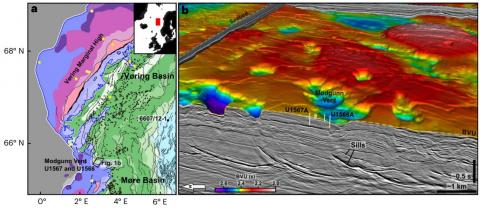
The authors, including Eric Ferré, present seismic data and the results of a five-borehole ocean drilling transect sampling the crater of a hydrothermal vent complex in the Northeast Atlantic. These results were obtained during a recent International Ocean Discovery Program (IODP) expedition off the coast of Norway.
Stable carbon isotope stratigraphy and dinoflagellate cyst biostratigraphy reveal a negative carbon isotope excursion coincident with the appearance of the index taxon Apectodinium augustum in the vent crater, firmly tying the infill to the PETM.
The shape of the crater and stratified sediments suggests large-scale explosive gas release during the initial phase of vent formation followed by rapid, but largely undisturbed, diatomite-rich infill. Moreover, the paper shows that these vents erupted in very shallow water across the North Atlantic Igneous Province, such that volatile emissions would have entered the atmosphere almost directly without oxidation to CO2 and at the onset of the PETM.